
Guide · Verification
Testing and COAs.
A useful BPC-157 certificate of analysis (COA) ties one specific lot to lab results: a lot number that matches the label, HPLC purity, identity confirmed by mass spectrometry, and the testing lab and date. Palm Beach Vitality provides lot-specific COAs on request.
Anatomy of a COA
Check five things on any BPC-157 COA: the compound and sequence, the lot number, HPLC purity, mass-spec identity, and who tested it and when.
- Compound
- BPC-157 · GEPPPGKPADDAGLV 1
- Lot no.
- [matches your label] 2
- HPLC purity
- [__._ %] 3
- Mass spec
- [observed] vs 1419.5 expected 4
- Lab · date
- [lab name] · [test date] 5
- Compound and sequence. Should name BPC-157 and match GEPPPGKPADDAGLV.
- Lot number. Must match the number printed on your pen or vial.
- HPLC purity. Reported as a percentage of the total peak area.
- Mass-spec identity. Observed mass consistent with BPC-157’s molecular weight of about 1419.5 g/mol. 1
- Testing lab and date. A named lab and a test date for that lot.
Reading HPLC purity
HPLC pushes a sample through a column and records each component as a peak. Purity is the main peak’s share of the total peak area. A shorter chain, or another ingredient in a blend, shows up as its own peak.

01 · Left to right
Time along the bottom
The horizontal axis is retention time, in minutes. The sample enters the column at 0. Each molecule travels at its own speed, so it appears at its own minute.
02 · Bottom to top
UV absorbance
The vertical axis is how much ultraviolet light the detector absorbed. A taller point means more material was passing the detector at that moment.
03 · The tall peak
The target peptide
The large peak is the compound the test was looking for. On a pure sample it should dwarf everything else on the trace.
04 · The small peaks
Impurities
The short peaks are other material: a shortened chain, leftover reagent, or another ingredient. They count in the purity math.
05 · The percentage
Main peak area divided by every peak
Purity is the area under the main peak divided by the area under all the peaks. The chart itself does not name the molecule. Identity is a separate test.
A real certificate
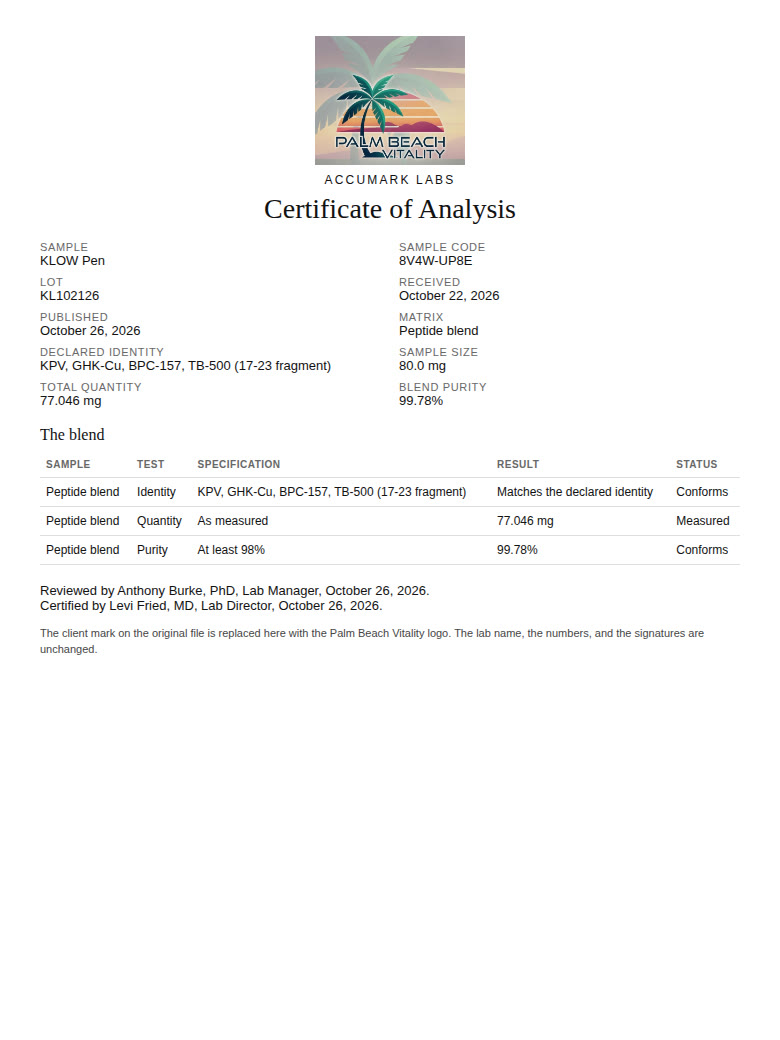
This is a certificate Accumark Labs issued for a KLOW pen, a blend that includes BPC-157. Palm Beach Vitality uses this lab. The pages move left to right: the blend, then each peptide, then the safety screens. The chromatogram under those pages is the trace behind the 99.78 percent blend purity.
It is not the certificate for a BPC-157-only pen or vial. Those lots have their own certificates. On this one, BPC-157 is one of four named peptides. The client mark that originally read UMS has been replaced with the Palm Beach Vitality logo. The lab name, the numbers, and the signatures are unchanged.


Page 1 · The blend
One sample, one total
Accumark received the KLOW pen on October 22, 2026 and published this certificate on October 26. Sample code 8V4W-UP8E, lot KL102126. The lab lists four peptides, a measured total of 77.046 mg against 80 mg declared, and a blend purity of 99.78 percent. The chromatogram above is the picture behind that percentage. Anthony Burke, PhD, reviewed it. Levi Fried, MD, certified it.
Page 2 · Each peptide
BPC-157 on its own line
For BPC-157 the lab reports identity conforms, quantity 9.688 mg, and purity 99.881 percent, against a specification of at least 98 percent. The same three tests are reported for KPV, GHK-Cu, and the TB-500 17–23 fragment. Conforms means the result met the lab’s specification. It is not an FDA approval.
Page 3 · Two more screens
Endotoxin and microbes
Endotoxin is a residue from bacterial cell walls. The lab used the LAL method from USP <85> and reported the result below what the test could quantify. A separate PCR screen looks for microbial DNA. The result is not detected. Neither test is a clinical trial.
Supplier red flags
Be wary of any research peptide seller that makes health claims, gives dosing advice, or can’t produce a lot-specific COA. Products sold online may not contain what the label says. 2
- Health or healing claims for a research-use-only product.
- Dosing charts, “protocols” or usage instructions.
- Before-and-after photos or testimonials.
- A COA with no lot number, no lab name or no date.
- One generic COA used for every batch.
Requesting a COA
From Palm Beach Vitality
Contact the store with your product name and the lot number printed on the label, and ask for that lot’s HPLC purity and mass spectrometry results.
Sources
- National Center for Biotechnology Information. PubChem Compound Summary for CID 9941957, BPC-157. pubchem.ncbi.nlm.nih.gov
- Harvard T.H. Chan School of Public Health. Peptides are all over social media and the news. Here’s what to know about them. hsph.harvard.edu
- Accumark Labs. Certificate of analysis for KLOW Pen, sample 8V4W-UP8E, lot KL102126, published October 26, 2026. The client logo on the file shown here has been replaced with the Palm Beach Vitality logo. The reported results are unchanged.